


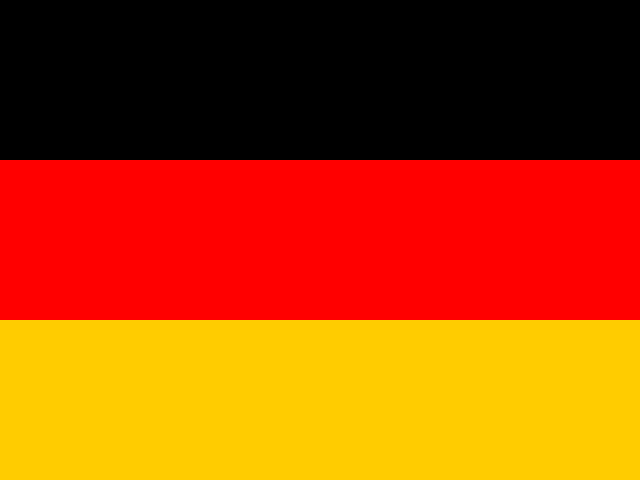








Yes, CBD is legal in Germany. Since 1 April 2024, the German Cannabis Act (KCanG) explicitly excludes CBD from its definition of cannabis. Hemp counts as industrial hemp, not cannabis, when it is traded for commercial purposes that rule out misuse for intoxication and comes from EU-certified varieties or contains no more than 0.3% THC. Which further rules apply depends on the product: cosmetics, foods and medicines each have their own. Formula Swiss CBD oils are notified as cosmetics in the EU and registered with a pharmacy product number (PPN) in Germany.
Key facts
- Is CBD legal?
- Yes. The Cannabis Act (KCanG, in force since 1 April 2024) excludes CBD from the definition of cannabis.
- THC limit for hemp
- 0.3%, or hemp from EU-certified varieties, traded only for commercial or scientific purposes that rule out misuse for intoxication
- CBD cosmetics
- Covered by the EU Cosmetics Regulation; products must be notified in the EU portal (CPNP)
- CBD in food
- Treated as a novel food in the EU, which needs authorisation before sale
- Driving
- The limit is 3.5 ng THC per ml of blood serum (§ 24a StVG)
- Our oils
- Notified as cosmetics (CPNP), registered with a PPN in Germany, full spectrum under 0.2% THC or THC-free
What the German Cannabis Act says about CBD
The Cannabis Act (Konsumcannabisgesetz, KCanG) came into force on 1 April 2024. It legalised limited possession and home growing of cannabis for adults, and it also made the status of CBD clearer.
The law defines "cannabis" as the plants, flowers, other plant parts and resin of the cannabis genus, but lists five exceptions. Two of them matter here: CBD and industrial hemp (Nutzhanf) (§ 1 No. 8 KCanG). The law also allows the extraction of CBD (§ 2 KCanG).
Industrial hemp is defined in § 1 No. 9 KCanG. Hemp plants and plant parts count as industrial hemp when:
- trade in them (apart from cultivation) serves only commercial or scientific purposes that rule out misuse for intoxication, and
- they come from EU cultivation with certified seed of varieties in the EU Common Catalogue, or their THC content does not exceed 0.3%.
So for a finished CBD product, two things count: the THC content and the purpose for which it is sold.
Which rules apply to which CBD product?
Once CBD is outside the drug laws, the product category decides which other rules apply.
| Product type | Main rules | What it means |
|---|---|---|
| Cosmetics (oils for the skin, balms, creams) | EU Cosmetics Regulation (EC) No 1223/2009 | Safety assessment, product information file and notification in the CPNP before sale |
| Food and food supplements | EU Novel Food Regulation (EU) 2015/2283 | CBD extracts are novel foods and need EU authorisation before they can be sold as food |
| Medicines | German Medicines Act | A CBD medicine for certain severe forms of epilepsy is available on prescription |
| Products with more than 0.3% THC | KCanG or the Medical Cannabis Act | Not industrial hemp; the cannabis rules apply |
The European Food Safety Authority (EFSA) said in 2022 that the safety of CBD as a novel food could not yet be established, because of data gaps (EFSA, 2022). In 2026, EFSA updated its statement and proposed a provisional safe intake for food supplements made with highly purified CBD (EFSA, 2026). Read more in our article on CBD as a novel food in the EU.
Can you buy CBD oil from another EU country?
Yes. In 2020, the Court of Justice of the European Union ruled that a member state may not ban the marketing of CBD that has been lawfully produced in another member state, even when it is extracted from the whole hemp plant. The Court found that CBD "does not appear to have any psychotropic effect or any harmful effect on human health". A ban can only be justified if the risk to public health is sufficiently established (Court of Justice of the EU, case C-663/18).
CBD and driving in Germany
CBD itself is not intoxicating and is not part of the driving limit. The limit applies to THC: since 2024, driving with 3.5 ng/ml or more of THC in blood serum is an administrative offence (§ 24a (1a) StVG). For drivers under 21 and those on probation, the rule is zero THC (§ 24c StVG). Full-spectrum hemp products contain small amounts of THC, so read our guide to CBD, drug tests and driving.
From our experience
All our CBD oils are notified as cosmetics in the EU's CPNP portal, each has a detailed product information file, and the skin tests were carried out on 50 people in Germany. The oils are also registered with a pharmacy product number (PPN) through the IFA in Germany. Our full-spectrum oils contain less than 0.2% THC, well below the 0.3% limit, and every production batch is tested.
Frequently asked questions
Is CBD oil legal in Germany?
Yes. The German Cannabis Act excludes CBD from the definition of cannabis. A CBD oil must also meet the rules for its product category, for example the EU Cosmetics Regulation for oils sold as cosmetics.
How much THC may CBD products contain in Germany?
Hemp counts as industrial hemp when it comes from EU-certified varieties or contains no more than 0.3% THC, and is traded only for purposes that rule out misuse for intoxication. Products above that are covered by the cannabis rules.
Did the 2024 cannabis law change the rules for CBD?
It made them clearer. Since 1 April 2024, the Cannabis Act names CBD and industrial hemp as exceptions to its definition of cannabis, and it allows the extraction of CBD.
Can I drive after using CBD in Germany?
CBD is not part of the driving limit. The limit applies to THC: 3.5 ng/ml in blood serum. Full-spectrum products contain small amounts of THC, so a THC-free product is the safer choice if you drive.
Can I order CBD oil from another EU country to Germany?
Yes. The EU Court of Justice ruled in 2020 that a member state may not ban CBD lawfully produced in another member state unless a risk to public health is sufficiently established.
Are Formula Swiss CBD oils legal in Germany?
Yes. Our CBD oils are notified as cosmetics in the EU (CPNP) and registered with a pharmacy product number (PPN) in Germany. The full-spectrum oils contain less than 0.2% THC, and the broad-spectrum oils are THC-free.
Related guides
This article is general information about the law as of the review date below. It is not legal advice, and laws can change. Formula Swiss CBD oils are sold as cosmetics for use on the skin. They are not food supplements or medicines and are not intended to diagnose, treat, cure or prevent any disease.
Last reviewed:
Sources
- Gesetz zum Umgang mit Konsumcannabis (Konsumcannabisgesetz, KCanG), § 1 Begriffsbestimmungen and § 2. Federal Ministry of Justice, gesetze-im-internet.de.
- Straßenverkehrsgesetz (StVG), § 24a and § 24c. Federal Ministry of Justice, gesetze-im-internet.de.
- Court of Justice of the European Union. Judgment in case C-663/18, B S and C A (Kanavape), press release No 141/20, 19 November 2020.
- EFSA Panel on Nutrition, Novel Foods and Food Allergens. Statement on safety of cannabidiol as a novel food: data gaps and uncertainties. EFSA Journal 2022;20(6):e07322. doi:10.2903/j.efsa.2022.7322
- EFSA Panel on Nutrition, Novel Foods and Food Allergens. Update of the statement on safety of cannabidiol as a novel food. EFSA Journal 2026;24(2):e9862. doi:10.2903/j.efsa.2026.9862
- Regulation (EC) No 1223/2009 of the European Parliament and of the Council on cosmetic products. EUR-Lex
- Formula Swiss. Registered, compliant and legal products.


